












Hydraulic Guillotine vs. Swing Beam Shearing Machines: The Cutting Capacity Guide
Release Time:
2025-12-08
Introduction

In the world of metal fabrication, cutting is the first operation. Before you can bend, weld, or machine a part, you need to cut it from raw sheet. For shops processing high volumes of steel plate, the hydraulic shearing machine is the workhorse of the cutting department.
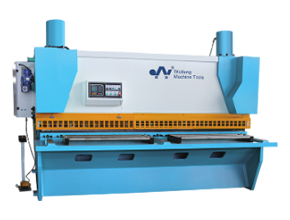
But not all shears are created equal. When shopping for a Havi CNC shearing machine, you will encounter two primary types: the QC11K Hydraulic Guillotine Shear and the QC12K Swing Beam Shear. While both machines cut metal, the way they do it and the quality of the cut are fundamentally different.
In this comprehensive guide, we will explore the mechanics of each design, the critical role of rake angle in cutting performance, and why the guillotine shear is considered the gold standard for precision work despite its higher cost.
The Mechanics of Shearing: How Metal is Cut

Unlike a laser or plasma cutter which melts material, a shearing machine works like a giant pair of scissors. One blade (the upper blade) presses down onto another blade (the lower blade), causing the metal to fracture along a line.
The Role of Rake Angle
The “Rake Angle” (also called Shear Angle) is the angle at which the upper blade descends relative to the lower blade. This is the single most important factor affecting cut quality.
Why does the angle matter? When the blade hits the metal at a 90-degree angle (perpendicular), the entire length of the blade engages simultaneously. This requires enormous force and creates a rough, uneven cut with excessive burr. By introducing a rake angle (typically 0.5 to 3 degrees), the blade slices progressively from one side to the other, reducing the required force and improving cut quality.
The QC12K Swing Beam Shear: Budget-Friendly Simplicity
How It Works
The Swing Beam design is mechanically simple. The upper blade is mounted on a beam that pivots around a fixed hinge point at the rear of the machine. When hydraulic cylinders push down at the front, the beam swings down in an arc, bringing the blade into contact with the material.
The rake angle is **fixed by the geometry of the beam**. It is determined by the radius of the swing arc and cannot be adjusted without physically rebuilding the machine.
Advantages of Swing Beam
- Lower Cost: Fewer moving parts and simpler hydraulics make it 20-30% cheaper than a guillotine shear of equivalent capacity.
- Compact Design:The swinging motion allows for a smaller footprint.
- Easy Maintenance:Simple pivot bearings are easier to service than the precision linear guides of a guillotine.
Limitations of Swing Beam
The fundamental problem is that the rake angle is not optimized for all materials. A swing beam machine might have a fixed rake angle of 1.5 degrees. This works acceptably for mid-thickness steel (4-8mm). However, for thin materials (1-2mm stainless steel), this angle is too aggressive, causing the strip to twist and curl. For thick materials (16-20mm), the angle is insufficient, resulting in excessive burr and blade wear.
The QC11K Hydraulic Guillotine Shear: The Precision Standard
How It Works
The Guillotine Shear (also called a Gate Shear) features an upper blade that moves vertically downward in a perfectly straight line, guided by precision linear bearings. The rake angle is created by physically tilting the upper blade holder at an adjustable angle.
On Havi QC11K machines, the rake angle can be adjusted from **0.5 degrees to 3 degrees** (depending on model) by rotating an eccentric adjustment shaft. This allows the operator to fine-tune the angle based on material thickness and type.
Advantages of Variable Rake Angle
For Thin Materials (1-3mm): Use a shallow rake angle (0.5 to 1 degree). This reduces the lateral force on the strip, preventing twisting and edge curl. This is critical for HVAC duct work or automotive panels where flatness is essential.
For Thick Materials (12-25mm):Use a steeper rake angle (2 to 3 degrees). The progressive cutting action reduces peak tonnage, allowing the machine to cut thicker material than the rated capacity suggests. It also improves blade life by distributing wear.
The Blade Gap Adjustment Advantage
Guillotine shears also feature precise blade gap adjustment(the clearance between upper and lower blades). For soft materials like aluminum, a tighter gap (0.05mm per mm of thickness) produces a cleaner cut. For hard materials like tool steel, a wider gap prevents chipping. Swing beam shears typically have fixed or very limited gap adjustment.
Deep Dive: The Thin Strip Twisting Problem
One of the most frustrating issues for fabricators is when cutting thin strips (50-200mm wide, 1-2mm thick) results in a twisted, unusable part. This happens because of the lateral force component introduced by the rake angle.
The Physics of Twisting
As the angled blade cuts from left to right, it doesn't just push down it also pushes sideways. For a wide sheet (1500mm), the material is heavy and stable, so this lateral force is negligible. But for a narrow strip (100mm), the lateral force can exceed the material's torsional stiffness, causing it to twist like a propeller blade.
How Guillotine Shears Solve This
By reducing the rake angle to 0.5 degrees (instead of the fixed 1.5-2 degrees of a swing beam), the lateral force is minimized. Additionally, Havi QC11K machines feature **hold-down clamps** with adjustable pressure. For thin materials, the operator increases the hold-down force to physically restrain the strip during cutting.
Data Comparison: QC11K vs. QC12K
Feature | QC12K (Swing Beam) | QC11K (Guillotine) |
Blade Motion | Arc (Swinging) | Straight Line (Vertical) |
Rake Angle | Fixed (typically 1.5 deg) | Variable (0.5 to 3 deg) |
Blade Gap Adjustment | Limited or Fixed | Fully Adjustable |
Thin Material (<2mm) | Prone to twisting | Excellent (Low rake mode) |
Thick Material (>12mm) | Acceptable | Superior (Reduced tonnage) |
Cut Quality (Burr) | Moderate | Minimal |
Blade Life | Good | Extended (Optimized angle) |
Price Point | Budget Friendly | Premium Investment |
Maintenance | Simple | Moderate (Linear guides) |
Material-Specific Cutting Challenges
Stainless Steel
Stainless steel is notorious for work hardening. A dull blade or incorrect rake angle causes the edge to harden, making subsequent cuts even harder. The variable rake angle of the QC11K allows you to use a more aggressive angle (2-2.5 degrees) which reduces cutting force and blade dulling.
Aluminum
Aluminum is soft and sticky. It tends to adhere to the blade, causing edge galling and a rough cut. The solution is a very tight blade gap (5-7% of material thickness) combined with a shallow rake angle (0.5-1 degree). Only guillotine shears offer this level of fine-tuning.
High Carbon Steel
Hard materials like spring steel or AR400 plate require maximum cutting force. Paradoxically, using a **steeper** rake angle (2.5-3 degrees) reduces peak tonnage by spreading the cut over time, preventing blade fracture.
Blade Life and Long-Term Costs
Replacement blades for a 3-meter shear can cost $1,500 to $3,000 per set. If you are running three shifts, blade wear is a major operating expense.
The ability to adjust rake angle on the QC11K extends blade life by 30-50% because you can compensate for wear. As the blade dulls, you increase the rake angle slightly to reduce cutting force. On a swing beam shear with fixed geometry, once the blade dulls, cutting force increases exponentially until the blade must be replaced.
Which Shear Should You Buy?
**Choose the QC12K Swing Beam Shear If:**
- Budget is the primary constraint.
- You are cutting a narrow range of materials (e.g., only mild steel in 4-10mm range).
- You are a low-volume shop (fewer than 100 cuts per day).
- Space is limited and you need a compact machine.
Choose the QC11K Guillotine Shear If:
- You work with diverse materials (stainless, aluminum, mild steel).
- You frequently cut thin strips or high-precision parts.
- Production volume is high (blade life ROI matters).
- Edge quality is critical (minimal secondary finishing).
FAQ: Shearing Machine Questions
Can I upgrade a swing beam shear to have adjustable rake angle?
No. The rake angle is determined by the physical arc of the swing arm. Retrofitting is not feasible.
How often should I adjust the blade gap?
On a guillotine shear, check the blade gap whenever you change material types or thicknesses. A good rule of thumb is 7-10% of material thickness for mild steel, 5-7% for soft materials.
What is the typical cutting capacity difference?
For the same rated tonnage, a guillotine shear can often cut 10-15% thicker material than a swing beam shear because the optimized rake angle reduces required force.
Conclusion
While the QC12K Swing Beam Shear remains a cost-effective option for basic cutting operations, the QC11K Hydraulic Guillotine Shear represents the professional standard for shops that demand precision, versatility, and long-term value.
The ability to fine-tune rake angle and blade gap transforms shearing from a crude chopping operation into a precise cutting process. For fabricators working with stainless steel, aluminum, or thin-gauge materials, the guillotine shear is not a luxury it is a necessity.
Ready to upgrade your cutting precision? Explore the specifications of our QC11K Hydraulic Guillotine Shear or contact our team for a material-specific cutting analysis.
Previous Page:
Related News
NanTong HAVI CNC Machinery Co., Ltd.
Phone/WhatsApp: +86 17606524813
Address: Libao Development Area,HaiAn jiangsu China