











The Critical Difference Between Single-Action and Double-Action Hydraulic Presses
Release Time:
2025-11-22
The Critical Difference Between Single-Action and Double-Action Hydraulic Presses

In the metal forming industry, "Deep Drawing" is considered one of the most difficult manufacturing processes to master. Unlike simple bending or punching, deep drawing involves stretching a flat sheet of metal (the blank) into a hollow 3D shape, such as a kitchen sink, a fire extinguisher cylinder, or an automotive body panel.
If you have ever tried to wrap a flat sheet of paper around a ball, you know the problem: the paper crinkles and folds. Metal behaves the same way. Without the correct mechanical control, the metal will either Wrinkle (if it flows too easily) or Tear (if it is stretched too hard).
The secret to preventing these defects lies in the type of machine you use. While a standard Single-Action Press is excellent for bending, it often fails at deep drawing. To form complex shapes, you need the advanced capabilities of a Double-Action Press (or a Single-Action press equipped with a Hydraulic Cushion).
In this technical guide, we will analyze the mechanics of material flow and explain why the HAVI YWF27 Series is the industry standard for deep drawing applications.
The Physics of Deep Drawing: The Tug-of-War
To understand the machinery, you must first understand the behavior of the metal. Deep drawing is a "tug-of-war" between material flow and tension.
When the punch pushes the center of the metal sheet into the die:
- 1. Radial Tension: The metal on the outer edges (the flange) is pulled inward toward the center.
- 2. Compression: As the large outer circle is pulled into a smaller diameter, the material circumference must shrink. This creates compressive stress.
The Failure Modes

- Wrinkling: If the compressive stress is too high and there is nothing holding the metal flat, the flange will buckle and fold over itself.
- Tearing (Fracture): If the metal is held too tightly and cannot flow inward, the punch will punch right through the bottom of the cup.
To create a perfect part, you must apply Controlled Resistance to the flange. You need to hold it tight enough to prevent wrinkles, but loose enough to allow the metal to flow into the die.
Single-Action Presses: The Limit of Simplicity
A standard Single-Action Hydraulic Press has one main cylinder (the Slide) that moves down.
How It Works
- The ram moves down, the tool hits the metal, and pushes it into the die.
- The Problem: There is no active mechanism to hold the edges of the blank.
- The Workaround: Fabricators often try to use springs or nitrogen gas springs in the die set. However, springs provide uneven pressure, which is the opposite of what deep drawing usually needs.
Verdict: Single-Action presses are excellent for stamping, coining, and shallow forming, but for deep cups (where depth > diameter), they struggle to control material flow.
Double-Action (or Cushion-Equipped) Presses: The Solution
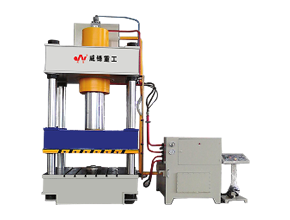
A Double-Action press (or a modern press like the HAVI YWF27 with a Hydraulic Cushion) introduces a second force vector.
The Two Actions
- 1. Action 1 (The Punch): The main cylinder pushes the punch down to form the part.
- 2. Action 2 (The Blank Holder/Cushion): A secondary hydraulic system (usually located in the bed of the machine) pushes upward against the edges of the material.
The HAVI YWF27 Workflow
When you run a cycle on the HAVI YWF27 Deep Drawing Press, the process is synchronized:
- Loading: The flat blank is placed on the die.
- Clamping: The main slide moves down. Before the drawing begins, the upper die ring contacts the blank holder.
- Drawing: The main slide continues to move down. Crucially, the cushion resists this movement with a programmable force. This 'squeezes' the flange of the metal, preventing wrinkles.
- Ejection: Once the slide retracts, the hydraulic cushion pushes back up, ejecting the finished part.
Comparison Table: Single vs. Double Action
For production managers deciding on machinery, here is the breakdown:
Feature | Single-Action (Standard) | Double-Action (with Cushion) |
Active Cylinders | One (Top) | Two (Top + Bottom Cushion) |
Material Control | Minimal (Relies on springs) | Active Hydraulic Force |
Defect Control | High risk of Wrinkling | Eliminates Wrinkling |
Draw Depth | Shallow / Simple shapes | Deep / Complex shapes |
Tooling Cost | Higher (Complex dies needed) | Lower (Machine handles the force) |
Best Application | Bending, Punching, Coining | Pots, Sinks, Tanks, Auto Parts |
Feature Highlight: The Hydraulic Cushion
The "Heart" of the YWF27 series is the Hydraulic Cushion. Unlike mechanical springs, a hydraulic cushion provides Constant Pressure throughout the entire stroke.
- Pressure Adjustment: You can adjust the cushion pressure on the HAVI PLC touchscreen. If the part tears, lower the pressure. If it wrinkles, increase the pressure.
- Delayed Action: The cushion can be programmed to hold the part down for ejection or retract at specific times.
FAQ: Deep Drawing Queries
- Q: Can I turn off the cushion to use the press for standard bending?
A: Yes. On the HAVI YWF27 Series, the hydraulic cushion can be deactivated or retracted fully, allowing the machine to function as a standard single-action press.
- Q: What is the "Draw Ratio"?
A: It is the ratio between the diameter of the blank and the diameter of the punch. Generally, a single draw operation should not exceed a ratio of roughly 1.8 to 2.0.
- Q: Why is my part tearing at the bottom corner?
A: This usually means the "Blank Holder Force" (Cushion pressure) is too high. The friction is preventing the metal from flowing into the die.
Conclusion
Deep drawing is a balancing act. If you pull too hard, it breaks; if you hold too loosely, it wrinkles. Trying to achieve this balance with a simple Single-Action press is inefficient and often impossible for complex parts.
The HAVI YWF27 Hydraulic Press brings the capabilities of a Double-Action system to your shop floor. By integrating an active Hydraulic Cushion, it gives you precise control over material flow, allowing you to manufacture high-quality, defect-free deep-drawn parts.
Struggling with high scrap rates in your forming department? Contact HAVI CNC Team to discuss how our hydraulic press solutions can optimize your production process.
Related News
NanTong HAVI CNC Machinery Co., Ltd.
Phone/WhatsApp: +86 17606524813
Address: Libao Development Area,HaiAn jiangsu China