











How to Prevent "Twisting" and "Bowing" When Shearing Narrow Strips
Release Time:
2025-11-27
How to Prevent "Twisting" and "Bowing" When Shearing Narrow Strips

In the metal fabrication industry, the hydraulic shearing machine is the workhorse of the blanking department. For 90% of jobs—cutting large rectangular panels—the process is straightforward. However, as soon as an operator attempts to cut Narrow Strips (where the width of the cut is less than 10-15 times the material thickness), trouble begins.
The strip comes out looking like a corkscrew (Twist), a banana (Camber), or a curled ribbon (Bow). These deformed parts are often unusable, requiring expensive secondary straightening operations or ending up in the scrap bin.
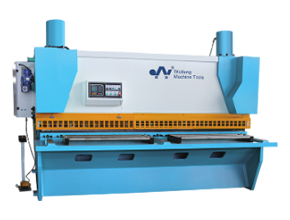
While many operators blame the material or the blade sharpness, the root cause is often simple physics: The Rake Angle. In this technical guide, we will analyze the three primary shearing defects, explain the physics behind them, and demonstrate why a HAVI QC11Y Hydraulic Guillotine Shear with adjustable rake angle is the only reliable solution for cutting precise narrow strips.
Identifying the Enemy: The 3 Types of Shearing Distortion
Before fixing the problem, we must identify it. Distortion in narrow strips manifests in three distinct ways:
1. Twist (The Corkscrew)
This is the most common and damaging defect. The strip rotates along its longitudinal axis, looking like a piece of DNA or a corkscrew.
- Cause: Excessive rake angle applies torque to the narrow piece as it shears off.
2. Bowing (The Curl)
The strip curls upward or downward at the ends, preventing it from laying flat on a table.
- Cause: Usually related to material stress release or incorrect blade gap settings, but exacerbated by high cutting angles.
3. Camber (The Banana)
The strip remains flat but curves sideways, so the edges are not straight.
- Cause: Often caused by the sheet slipping under the hold-downs or uneven blade gap pressure.
The Physics: Why Does Twisting Happen?
To cut metal, the upper blade of a shearing machine is tilted at an angle relative to the lower blade. This is called the Rake Angle (or Cutting Angle).
Think of the rake angle like a pair of scissors. You don't close the blades all at once; you slice from one end to the other. This reduces the tonnage required to make the cut.
However, this angle creates a force vector problem:
1. Vertical Force: Cuts the metal (Good).
2. Horizontal Force: Pushes the material sideways (Bad).
When cutting a large plate, the bulk of the material is heavy enough to resist this horizontal force and stay flat. But when you cut a Narrow Strip, there is no mass to resist the force. The rake angle acts like a wedge, physically twisting the strip away from the blade as it shears.
The Golden Rule: The higher the rake angle, the more severe the twist.
The Solution: Variable Rake Angle (Guillotine Series)

This is where machine selection becomes critical. Not all shearing machines are created equal.
The Problem with Swing Beam Shears (QC12Y)
The standard Swing Beam Shear (often called the QC12Y model) is a cost-effective, reliable machine. However, its upper blade moves in a fixed arc. You cannot change the rake angle.
- The angle is fixed (usually around 1.5° to 2.0°) to ensure the machine can cut its maximum rated thickness.
- When you try to cut thin, narrow strips, that fixed 2° angle is too aggressive, causing inevitable twisting.
The Solution: Guillotine Shears (QC11Y)
The HAVI QC11Y Hydraulic Guillotine Shear features a vertical slide motion. Crucially, it allows the operator to adjust the Rake Angle.
- For Thick Plate: You increase the angle (e.g., 2.0°) to maximize cutting power.
- For Narrow Strips: You decrease the angle (e.g., 0.5° or 1.0°).
By reducing the rake angle to the minimum setting required to break the material, you drastically reduce the horizontal force vector. The result? The strip comes out flat, straight, and usable.
Comparison: Swing Beam vs. Guillotine for Strip Cutting
If your shop processes a high volume of strips, the choice of machine will dictate your scrap rate.
Feature | Swing Beam Shear (QC12Y) | Guillotine Shear (QC11Y) |
Blade Motion | Arc / Circular | Vertical / Linear |
Rake Angle | Fixed (Cannot Adjust) | Adjustable (via CNC or Button) |
Blade Life | 2 Cutting Edges (Rhomboid) | 4 Cutting Edges (Rectangular) |
Cut Quality (Strips) | High risk of Twist/Bow | Excellent (Low Twist) |
Price Point | Lower | Higher (Premium) |
Best Application | General Fabrication | Precision Strips & Heavy Plate |
Step-by-Step Guide: How to Cut Perfect Narrow Strips
Using your HAVI QC11Y Series Machine, follow these steps to set up for a low-distortion cut.
Step 1: Minimize the Rake Angle
This is the most important step. On your CNC controller (e.g., E21S or DAC360), find the Rake Angle adjustment.
- Lower the angle as much as possible.
- Note: Lowering the angle increases the tonnage requirement. Ensure your machine has enough power.
Step 2: Tighten the Blade Gap
Narrow strips are sensitive to the gap between blades. If the gap is too wide, the material will roll over the bottom blade, causing a burr and increasing bowing.
- Set the blade gap to approximately 5-8% of the material thickness for strips (slightly tighter than the standard 10%).
Step 3: Check the Hold-Downs
Camber (banana shape) often happens because the sheet slips as the blade impacts it.
- Ensure the hydraulic hold-down cylinders are functioning correctly.
Step 4: Use the Backgauge Retract Function
Sometimes, the strip gets jammed between the bottom blade and the backgauge fence, causing it to curl upward.
- Modern CNC Shears have a 'Retract' function. The backgauge moves away slightly the instant the hold-downs engage, giving the strip room to fall freely after the cut.
Troubleshooting Checklist
- 1. Is the blade dull?
Dull blades require more force to fracture the metal, which translates into more stress and distortion in the part. Guillotine shears use 4-sided blades; try rotating to a fresh edge.
- 2. Is the material stress-relieved?
Sometimes the fault lies in the steel coil itself. Cold-rolled steel often has internal stresses. When you slice a narrow strip, you release that tension, and the metal curls naturally.
- 3. Are you cutting too narrow?
There is a physical limit. Generally, it is very difficult to shear a strip perfectly flat if the width is less than 8x to 10x the thickness. For widths narrower than this, laser cutting may be required.
FAQ: Shearing Distortion Queries
- Q: Can I retrofit a Swing Beam shear to have an adjustable rake angle?
A: No. The mechanical design of the swing arm pivot is fixed. This is why investing in the correct Shearing Machine Category upfront is vital if you plan to do strip work.
- Q: Does cutting speed affect twisting?
A: Generally, no. The twisting is caused by geometry (rake angle), not speed. However, shock from high-speed impact can sometimes cause slippage.
- Q: Why does my Guillotine shear cost more than the Swing Beam?
A: The Guillotine design is more complex. It requires a rigid linear guide rail system, adjustable rake mechanism, and typically a heavier frame structure to maintain accuracy.
Conclusion
Twisted and bowed strips are not an inevitable part of the shearing process—they are a symptom of using the wrong settings or the wrong machine design.
While Swing Beam shears are excellent for standard fabrication, the HAVI QC11Y Hydraulic Guillotine Shear stands alone as the master of precision strip cutting. Its ability to lower the rake angle minimizes the horizontal forces that cause distortion, delivering flat, straight parts directly from the machine.
Tired of throwing away twisted metal? Contact HAVI CNC Team today. Let us help you calculate the ideal machine specifications to eliminate scrap and improve your production quality.
Related News
NanTong HAVI CNC Machinery Co., Ltd.
Phone/WhatsApp: +86 17606524813
Address: Libao Development Area,HaiAn jiangsu China